




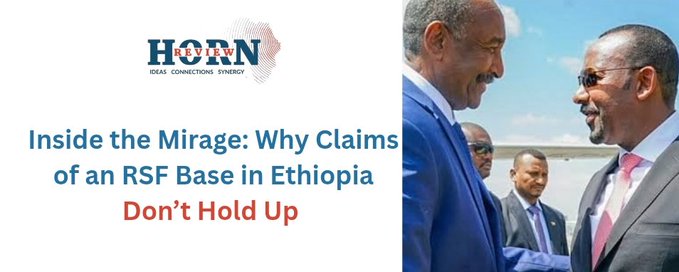
Debunking Claims of a Military Base in Ethiopia for Sudan’s Rapid Support Forces
Recent allegations suggest that Ethiopia is secretly hosting a military base to train the Rapid Support Forces (RSF) of Sudan. However, these claims primarily rely on inferences rather than solid evidence, lacking credible verification and authoritative sources. This article aims to analyze the context and implications of these serious allegations.
The Basis of the Claims
The assertions regarding the military base in Ethiopia come from unnamed sources, internal security documents, and interpretations of satellite imagery. Such evidence does not meet the rigorous standards required to substantiate a claim of state-sponsored training of a foreign militia. Notably, no Ethiopian officials or military authorities have confirmed these allegations directly.
Geographic and Operational Realities
Geographically, the alleged camp is situated within Ethiopian territory, making the logistics of RSF access highly implausible. Moving from RSF-controlled areas in Sudan to a site in Ethiopia would require traversing multiple regions under hostile or neutral control. This makes operational use of such a camp virtually unfeasible. The RSF’s core areas of operation are significantly deeper inside Sudan, with no straightforward route leading to Ethiopia.
Ethiopia’s Strategic Interests
Ethiopia’s military posture is shaped by its significant strategic interests, notably the Grand Ethiopian Renaissance Dam (GERD). The security of this crucial infrastructure is essential to safeguarding the country’s economic and energy future. Engaging with a foreign militia like the RSF—particularly at a sensitive site—would jeopardize Ethiopia’s internal stability and draw conflict closer, endangering both civilian life and critical installations.
A Defensive Stance
Ethiopia has maintained a careful and defensive approach to its borders, especially in the Benishangul-Gumuz region. This area has long been vulnerable to cross-border security threats, including arms trafficking and militia movements. The presence of military installations in this region serves as a legitimate defensive measure.
Analyzing Satellite Imagery
The interpretation of satellite imagery that supports the RSF training camp narrative lacks thorough consideration. Visible structures may closely resemble facilities for gold mining projects initiated by the Ethiopian government. The idea that these sites function as a foreign militia training facility remains unproven, especially given the absence of any training grounds or infrastructure typically associated with military training.
The Misinterpretation of Evidence
Many reports mispresent the physical layout depicted in satellite images, failing to recognize the absence of standard military training features. Most of the observed sites align with the requirements of a conventional military barracks, rendering claims of a foreign training base speculative.
Ignoring the Strategic Disincentive
Ethiopia would have little to gain and much to lose from facilitating the RSF’s operations. Historically associated with violence and instability, the RSF poses a direct threat to Ethiopia’s regional security. Any claims suggesting otherwise overlook Ethiopia’s genuine need to maintain stability at its borders.
Unverified Reports and Numerical Discrepancies
The reliability of the allegations is further called into question by unverified reports of external support and funding. Discrepancies in the numbers, such as the claim that a camp could accommodate 2,500 personnel while simultaneously stating that over 6,900 individuals were transported within a mere 48 hours, highlight the inconsistencies within the narrative.
Conditional Language in Reporting
Moreover, many secondary outlets have adopted assertive language that strips away the cautious phrases present in the original reports. This transformation can mislead the audience into accepting these allegations as fact rather than conjecture based on weak evidence.
Author Bias and the Broader Narrative
Analyzing the historical context of authors behind the claims raises questions about potential biases. Reports have often aligned with narratives critical of the Ethiopian government, particularly during the Tigray conflict. This history may influence the presentation and interpretation of ambiguous evidence.
The Regional Security Context
The tumultuous situation in Sudan, where Egypt and Eritrea are engaged in their own military operations, complicates the narrative around Ethiopia. In this light, Ethiopia’s defensive strategy in the Benishangul-Gumuz region reflects a broader commitment to securing its borders against external threats.
Legal and Diplomatic Considerations
From international law’s perspective, the allegations lack the requirements to substantiate claims of state responsibility. Mere presence of a military installation does not prove financial, logistical, or command support for a foreign armed group.
Conclusion: A Closer Look at Geopolitical Narratives
The claims regarding Ethiopia’s support for the RSF are woven into a complex fabric of geopolitical competition in the Horn of Africa. Allegations can reflect political agendas rather than established realities. Therefore, while such reports require examination, they should be approached with skepticism rather than a presumption of certainty.
The combination of geographic implausibility, legitimate defensive rationale, misinterpretations of evidence, and the historical context surrounding the authors undermines the credibility of the narrative. Ethiopia’s actions mirror a robust defense of its sovereignty, borders, and crucial infrastructure, challenging the idea that it would support foreign militias. Instead, these claims may serve broader agendas aimed at justifying external intervention in a region marked by instability.
For further context on the developments in East Africa, consider visiting trustworthy sources on Ethiopian security and the ongoing Sudanese conflict.
