




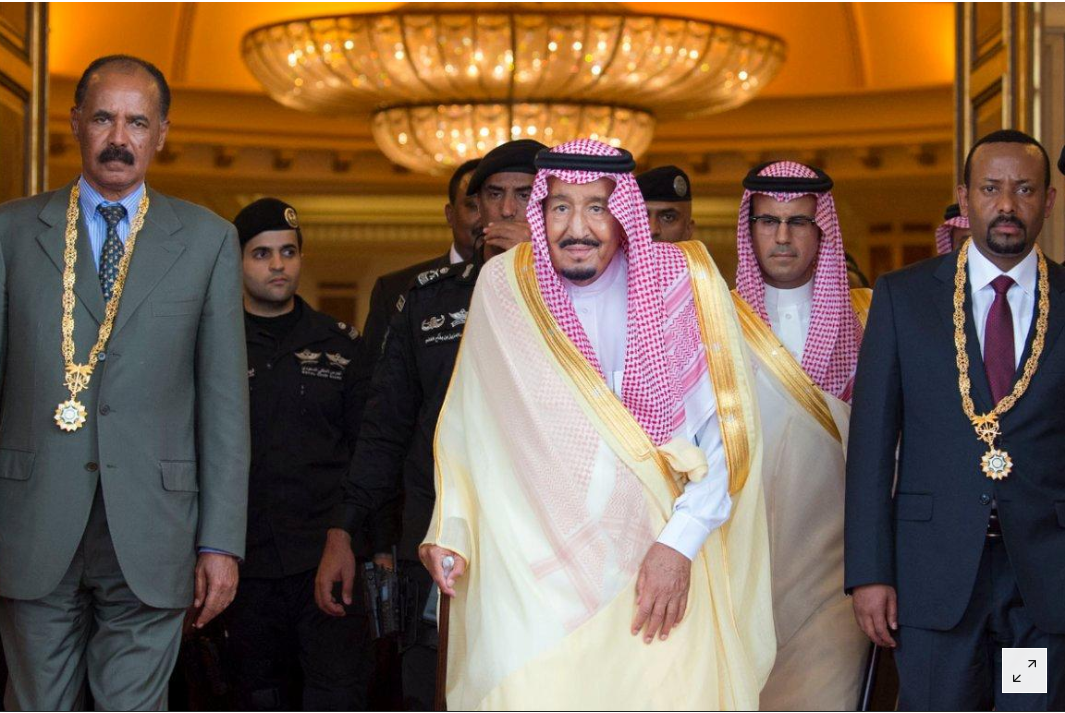
Algiers delivered a Cold War between Ethiopia and Eritrea. Jeddah delivered peace. Why are we looking back now?
More than two decades after it was signed, the Algiers Agreement continues to haunt relations between Eritrea and Ethiopia. It should not. In legal, political, and practical terms, Algiers is no longer the governing framework between the two states. The agreement that matters today is the Jeddah Peace Agreement of 2018—the most recent accord, the one that formally ended the state of war, and the only one that briefly normalized relations after years of destructive stalemate.
Yet recent statements by international actors, including the European Union, urging the parties to “respect the Algiers Agreement,” are deeply misguided. They rest on a selective reading of history and a weak grasp of how international law functions in practice. Algiers has long been defunct not through neglect, but because it proved impossible to implement on the ground. Despite early attempts, demarcating the Ethiopia–Eritrea border has been unworkable for social, anthropological, and historical reasons. Borderland communities are deeply intertwined and have consistently preferred integration over separation. Short of forced population displacement, the border envisioned under Algiers cannot be physically marked.
International law does not operate retrospectively. Nor does it treat treaties as frozen in time, immune to later developments. On the contrary, a basic principle of treaty law is that later agreements between the same parties supersede earlier ones, particularly when they address the same subject matter. The presumption is straightforward: the most recent agreement incorporates, modifies, or abandons what came before. To argue otherwise is to suggest that states can never move beyond failed arrangements—a proposition that would make diplomacy impossible.
The Algiers Agreement failed not because it was ignored, but because it proved unworkable. Its implementation collapsed almost immediately, producing the infamous “no war, no peace” condition that lasted from 2000 to 2018. Borders remained closed. Trade ceased. Families were separated. Militarization deepened. The agreement delivered neither peace nor normalization; instead, it institutionalized proxy hostility, and destabilizing acts without open conflict. That outcome was not accidental—it was the product of an agreement that resolved little beyond the formal cessation of fighting.
By contrast, the Jeddah Agreement explicitly ended the state of war. It reopened borders, restored diplomatic relations, and reintroduced economic and social ties. Its lifespan may have been short, but its legal and political significance was profound. It marked a conscious decision by both states to move past the impasse created by Algiers and to reset relations on a new basis.
This is why calls by Western institutions to revert to Algiers are perplexing. These actors are not neutral observers unfamiliar with the region’s history. They know that Jeddah—not Algiers—produced peace, however fragile. In fact, it is that most quintessential Western institution that awarded the Nobel Peace Prize to Prime Minister Abiy for reaching the Jeddah agreement with Eritrea’s President Isaias. Given this reality, to invoke Algiers now is not to defend international law; it is to elevate a failed framework over a functioning one, and to legitimize a return to the frozen conflict that destabilized the Horn of Africa for nearly two decades. Only those promoting conflict between Ethiopia and Eritrea would seek to go back to the Algiers agreement. Put simply, it is cynicism.
Such backward-looking diplomacy risks reinforcing the worst instincts of regional hardliners. It rewards legal formalism over political reality and encourages the resurrection of disputes that were, at least temporarily, set aside. Worse, it undermines the credibility of international mediation by signaling that agreements can be selectively ignored when they become inconvenient.
Algiers is not being sidelined arbitrarily. It has been superseded—by time, by events, and by a later agreement between the same sovereign parties. That is how international law is supposed to work. Treaties that cannot be implemented do not linger indefinitely as binding ghosts; they are replaced by new arrangements that reflect changed circumstances and political will.
If peace in the Horn of Africa is the objective, then the focus should be on strengthening, revising, or rebuilding upon the Jeddah framework—not exhuming an agreement whose primary legacy was paralysis. Calling on Eritrea and Ethiopia to “return” to Algiers is not conflict prevention; it is an invitation to relive the very conditions that made conflict inevitable.
International law looks forward, not backward. Diplomacy should do the same. The true path to peace and prosperity lays in integration and accommodation between Ethiopia and Eritrea, not separation.
