




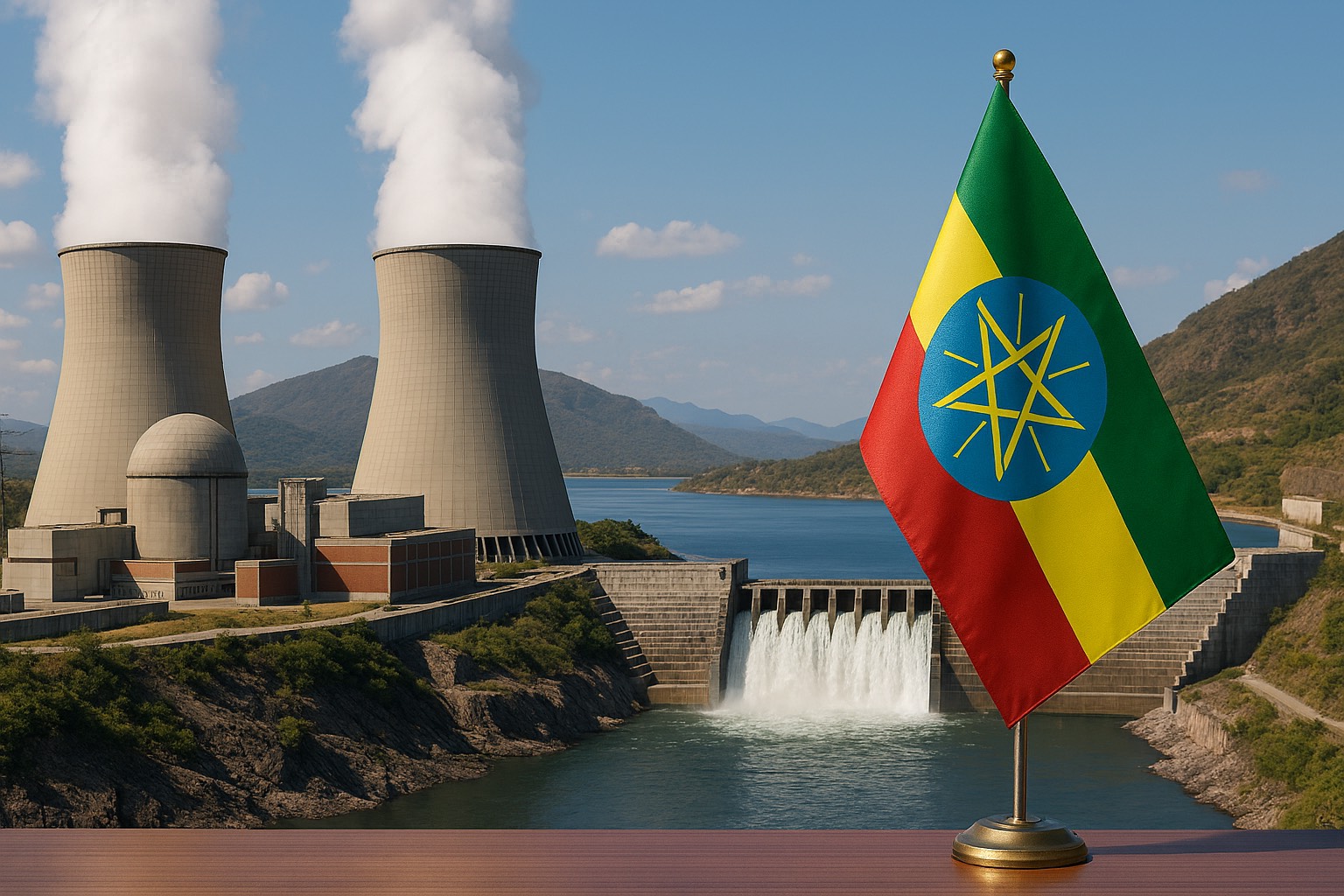
Ethiopia is quietly redefining its energy future. Once almost entirely dependent on the shifting fortunes of rivers and rainfall, the country is now embracing the atom — underpinned not by ideological allegiance, but by pragmatism, ambition and the hard arithmetic of development. In 2025, the IAEA formally backed Ethiopia’s bid to pursue nuclear energy, offering not only regulatory guidance but also support in human-capacity building, medical and agricultural uses of nuclear science. Welcome to Fana Media Corporation S.C+2BirrMetrics+2
The decision arrives amid growing recognition in Addis Ababa that hydropower — until now the backbone of the national grid — may no longer suffice. The majestic dams and hydroelectric schemes, including the celebrated Grand Ethiopian Renaissance Dam, have transformed the country’s energy landscape. Yet rapid population growth, accelerating industrialisation and recurrent droughts have exposed deep structural vulnerabilities in a hydro-heavy energy mix. Water flows fluctuate. Reservoir levels dip. Factories slow. Grid reliability falters. These are not just inconveniences but real impediments to manufacturing, export growth and economic resilience.
For Ethiopia’s leaders, nuclear energy offers what hydropower cannot: a reliable, weather-independent baseload capable of powering heavy industry, urban expansion and long-term national development. The plan is not to abandon renewables or hydropower, but to diversify — to stack complementary sources so that energy delivery becomes robust, stable, and future-proof.
Crucially, Ethiopia’s nuclear ambition is not tethered to a single partner or bloc. While a recent action plan was signed with one vendor, the government’s tone is resolutely neutral — a reflection of its broader foreign-policy posture. Rather than view nuclear cooperation as alignment, Ethiopia treats it as a technical endeavour. As Grossi put it during the IAEA’s 2025 conference: many countries, including developing economies, are discovering that “nuclear is returning not as a renaissance, but as realism.” Nuclear’s value lies now in dependable baseload, energy security and climate resilience — not grand ideological statements. Anadolu Ajansı+1
Under the agreement with the IAEA, Ethiopia is receiving support that extends beyond electricity generation. The Agency has pledged assistance in regulatory development, technical training, and even public-health infrastructure — including medical imaging and cancer treatment. A linear accelerator recently donated to Ethiopia’s largest public hospital signals this broader ambition: nuclear science as a lever for societal development, not only power. Welcome to Fana Media Corporation S.C+1
This generation of infrastructure plans envisages construction of large reactors in the coming decade — a bet on capacity that could reshape Ethiopia’s economic trajectory. But the vision does not ignore risk. The Ethiopian government is building regulatory institutions from scratch, seeking to meet global safety, security and non-proliferation standards. The story is not one of blind faith in technology, but of careful, methodical preparation — marrying ambition with caution.
In a global environment where nuclear energy is increasingly re-evaluated not for weapons but as a vector of stability, reliability and development, Ethiopia’s move is both bold and emblematic. It reflects a worldview in which energy sovereignty does not require exclusive allegiance, but instead the wisdom to blend resources, partners and technologies to build resilience.
If Addis Ababa can navigate the complexities ahead—financing, safety standards, local capacity, and public acceptance—it may succeed in reshaping not only its own grid, but also the regional energy landscape.
A country long defined by the rise and fall of its rivers is now betting on the atom.
