




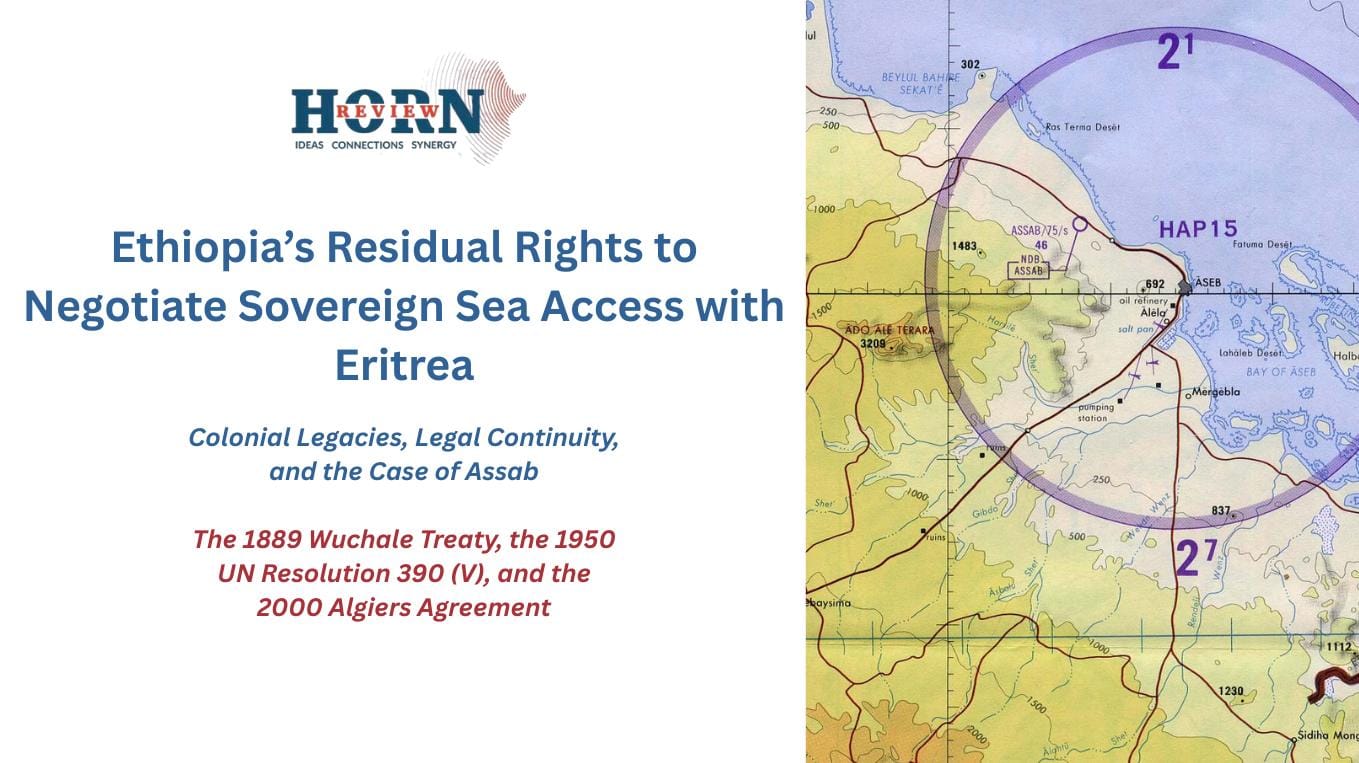
Colonial Legacies and Legal Continuity: The Case of Assab
Historical Context of Ethiopian Sovereignty
Ethiopia’s maritime rights and historical sovereignty have been influenced by a complex tapestry of colonial treaties, international resolutions, and legal battles. This article explores significant events, such as the 1889 Treaty of Wuchale, the 1950 United Nations General Assembly Resolution 390 (V), and the 2000 Algiers Agreement, that have shaped Ethiopia’s relationship with its coastal territories, particularly Assab.
The Wuchale Treaty: Initial Encroachments (1889)
The 1889 Treaty of Wuchale, signed under coercive conditions between Ethiopia and Italy, established a framework for territorial disputes that continues to resonate today. The treaty had two versions—one in Amharic and another in Italian. The Italian text imposed restrictions on Ethiopia’s ability to manage its foreign affairs independently. This contradiction led Emperor Menelik II to reject Italy’s protectorate claims, igniting the First Italo-Ethiopian War. Ethiopian forces achieved a decisive victory at the Battle of Adwa on March 1, 1896, compelling Italy to recognize Ethiopian sovereignty through the Treaty of Addis Ababa.
Italy’s foothold along the Red Sea began earlier, with its acquisition of Assab in 1869 through a commercial transaction involving local Afar leaders. Despite Italy’s subsequent colonial expansions, historical claims to these territories lacked legitimacy, as they were largely built on coercive agreements and misinterpretations of the Wuchale Treaty.
Post-Wuchale Developments: Boundary Treaties and Colonial Borders (1900-1935)
Following the Wuchale Treaty, further arrangements—specifically boundary treaties in 1900, 1902, and 1908—were executed under duress rather than negotiation between equal powers. These treaties delineated Ethiopia’s frontier with Eritrea but did not represent genuine cessions of sovereignty. Consequently, Ethiopia’s maritime rights over Assab and Massawa remained unresolved and vulnerable.
The colonial boundary arrangements, negotiated based on imprecise maps and influenced by socio-political pressures, inadequately reflected the historical interconnections of local communities. Consequently, Ethiopia’s maritime claims persisted as contentious issues, caught between colonial ambition and Ethiopia’s enduring resistance.
Restorative Efforts: UN Resolution 390(V) (1950)
In the aftermath of World War II, the 1950 UN General Assembly Resolution 390 (V) aimed to rectify colonial injustices by federating Eritrea with Ethiopia. This resolution acknowledged Ethiopia’s sovereignty over Eritrea while granting it administrative autonomy. Importantly, the UN mandated that Ethiopia’s coastal access—particularly to Assab—be preserved, independent of Eritrea’s potential independence. The federation was officially established on September 11, 1952, yet increasing tensions soon emerged, driven by Eritrean aspirations for greater autonomy.
Dissolution of the Federation: Reassertion of Sovereignty (1952-1974)
Frustrations surrounding the federal arrangement culminated in the Ethiopian parliament’s decision to dissolve the federation on November 14, 1962, officially integrating Eritrea as a province of Ethiopia. The incorporation was legally grounded in Ethiopia’s historical governance and aimed to safeguard national unity and maritime access. The decision to dissolve the federation was not arbitrary; it was deemed necessary to counteract rising subversion from local authorities in Eritrea.
The Derg Era: Escalation and Insurgency (1974-1991)
The overthrow of Emperor Haile Selassie and the rise of the Derg military junta marked a significant shift in Ethiopia’s strategy. The Derg’s focus on military governance and internal repression further alienated local populations and fueled Eritrean separatist movements. The Eritrean People’s Liberation Front (EPLF) launched a sustained insurgency, culminating in heightened tensions around Ethiopia’s strategic ports such as Assab and Massawa.
Ethiopia’s vulnerability became evident during the Ogaden War when reliance on alternative maritime routes highlighted the dire need for secure access to its previously controlled ports.
Eritrean Secession and the Implications for Maritime Access (1991-1993)
By the late 1980s, internal tension and the EPLF’s consolidation of power culminated in a power vacuum following the Derg’s collapse in 1991. Eritrea subsequently facilitated a referendum, leading to its formal independence in 1993. However, Ethiopia’s legal claims to Assab and Massawa remain contested, given the referendum’s flawed process and lack of participation from affected Ethiopian communities.
Post-Secession Relations and Ongoing Disputes (1993-1998)
Following Eritrea’s independence, tensions escalated, with Eritrea capitalizing on Ethiopia’s economic and logistical vulnerabilities. Unresolved border disputes, especially regarding territory like Badme, intensified relations, setting the stage for military conflict. By 1998, hostilities erupted as Eritrea initiated military incursions, leading to a full-scale war that further complicated regional stability.
The Algiers Agreement and Subsequent Challenges (2000-2018)
The 2000 Algiers Agreement established a framework to cease hostilities and delineate borders. However, it did not resolve the critical maritime disputes regarding Assab, leaving Ethiopia’s claims based on historical administration and international law unaddressed. The Ethiopia-Eritrea Boundary Commission (EEBC) focused primarily on terrestrial boundaries, neglecting maritime access—a critical facet of Ethiopia’s national security.
Recent Developments: A Path Toward Stability
The political transition in Ethiopia in 2018 offered a new trajectory of engagement with Eritrea, centered on historical rights to maritime access, particularly at Assab. This period has highlighted the importance of mutual recognition and cooperative dialogue to address ongoing disputes.
Ultimately, Ethiopia’s claims to Assab should be viewed as a legitimate effort to restore historical rights rather than an expansionist agenda. Secure maritime access is vital for Ethiopia’s regional integration and sustainable development.
Conclusion
Understanding the implications of colonial legacies on contemporary border disputes requires a nuanced approach that considers historical context, legal frameworks, and geopolitical realities. Ethiopia’s claims to territories like Assab remain legally and historically defensible, anchored in a commitment to cooperative diplomacy and mutual respect. Navigating these complex dynamics is essential for achieving long-term stability in the Horn of Africa and ensuring both nations can thrive in a cooperative and mutually beneficial environment.
