




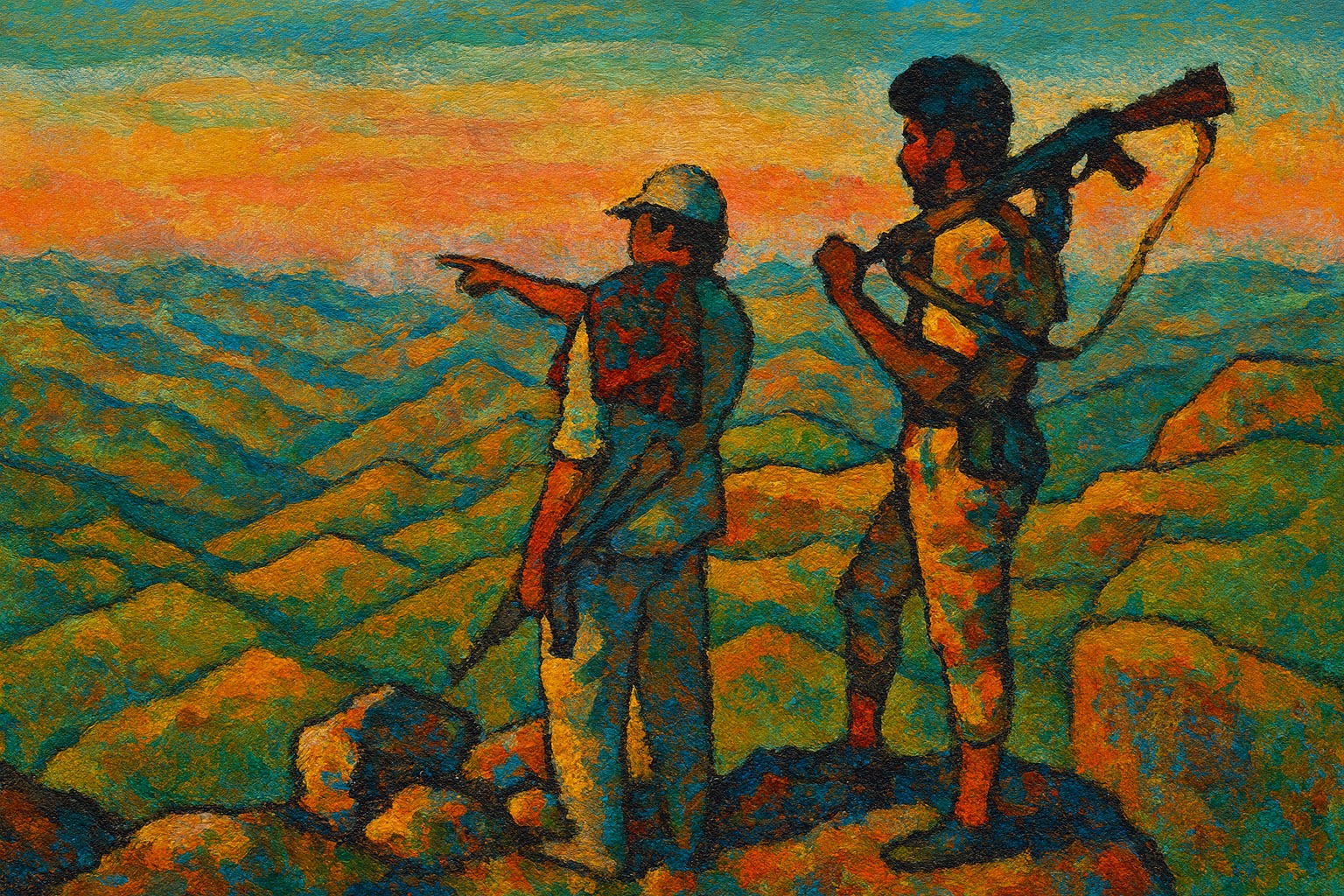
The Fano movement—often mischaracterized in public debate and even in some academic writing as a disciplined insurgent force capable of destabilizing Ethiopia’s federal order—is, in practice, a diffuse and internally fractious constellation of militias and political actors. Its architecture is defined less by cohesion than by decentralization, operational incoherence and the absence of any unifying ideological project or long-term strategic vision. While Fano has demonstrated episodic tactical effectiveness—particularly in provoking violence or disrupting local administration—it does not amount to a consolidated actor capable of mounting an existential challenge to the Ethiopian state. Its most tangible legacy has instead been destructive: prolonged insecurity across Amhara communities, mass displacement and recurring humanitarian crises, all without corresponding political gains or institutional leverage.
Fano’s mobilization draws on genuine and deeply rooted grievances among many Amharas—grievances stemming from historical marginalization, episodes of targeted violence and long-standing perceptions of state failure to provide security. But these sentiments have been selectively appropriated by a group of Amhara political elites, some of whom retain institutional or historical linkages to both the TPLF-era EPRDF and the post-2018 Prosperity Party. These elites misread the post-Tigray War balance of power. They assumed that Prime Minister Abiy Ahmed had exhausted his political capital, that federal security forces were overstretched and that the state itself was vulnerable to renewed internal insurgency. Their collaboration with the Ethiopian National Defense Forces during the Tigray War fostered an inflated sense of indispensability—the belief that the federal government’s survival depended on Fano’s participation. This misjudgment produced strategic decisions whose consequences fell largely on the very communities Fano claimed to defend.
During the Tigray War (2020–2022), groundwork for a post-war insurgency reportedly began to take shape. Public statements by figures such as Zemene Kassie suggest that roughly 5,000 fighters were trained in Eastern Gojjam as federal forces remained preoccupied in Tigray and elsewhere in Amhara. Weapons and logistics were diverted or looted from federal stockpiles, and certain leaders cultivated transnational linkages—particularly with Eritrea’s PFDJ—via long-standing networks originating in the EPRDF era and coordinated through Sudanese military intermediaries. These dynamics illustrate an unusual combination of elite-level political calculation and grassroots mobilization, though entirely devoid of transparency, institutional oversight or coherent operational integration.
By the time the war ended, Fano had already fragmented into rival factions with limited ability to project influence beyond their immediate localities. The Amhara Fano Popular Organization (AFPO), led by Eskinder Nega and formerly co-led with Dawit Hailegiorgis until his removal over alleged fund misappropriation, emerged in open rivalry with the Amhara Fano National Force (AFNM) headed by Zemene Kassie—previously known as the Eastern Gojjam Amhara Fano Movement. Other factions included Gondar Fano under Habte Wolde and Wollo Fano under Mere Wodajo, broadly aligned with Zemene Kassie. Additional units nominally under AFPO’s umbrella included Gojjam Fano under Captain Masresha Setie, Gondar Fano under Dereje Belay, Shoa Fano led by Meketaw Mamo and Wollo Fano under Colonel Fantahun Muhaba. Even among factions with nominal alliances, rivalry was persistent. Groups lacked shared command structures, competed fiercely for recruits and resources and regularly undermined one another. Personal ambition, territorial interest and mutual distrust shaped relations more than any coherent political or strategic agenda—underscoring the movement’s structural incoherence.
Fano’s participation in the Tigray War was driven by a political calculus that proved both reductive and self-defeating. Many militia leaders and sympathetic political elites—some inside government—believed that a TPLF return to power would revive decades of marginalization and targeted violence against Amharas, weakening their influence within state institutions. By contrast, they viewed the elimination of the TPLF as essential to containing what they saw as potential Oromo dominance in federal politics. Participation in the war was therefore framed as a defensive necessity. Yet the strategy boomeranged. Retaliatory TPLF incursions into Amhara territory displaced civilians, destroyed infrastructure and intensified ethnic violence. The primary cost was borne not by militia leaders but by the communities they purported to protect.
The post-war political landscape has produced striking realignments. Factions that once fought the TPLF in the name of protecting Amhara interests are now collaborating—directly or indirectly—with both the TPLF and Eritrea’s PFDJ against the federal government. This emergent alignment positions these groups to facilitate possible advances toward Addis Ababa, weakening federal institutions and state cohesion. Although government disarmament programs for non-state actors are frequently cited as justification for renewed militancy, preparations for confrontation predated these policies, revealing deliberate planning rather than spontaneous reaction. Leaders who opposed this trajectory have faced political marginalization, targeted smear campaigns and, in several cases, credible or successful assassination attempts. Captain Masresha Setie exemplifies those singled out for refusing collaboration with both the TPLF and PFDJ, and for resisting internal factional pressures.
The evolving Fano–TPLF–PFDJ nexus carries broader regional ramifications. Collaboration—whether tactical or opportunistic—with actors historically at odds with Ethiopian state sovereignty places Fano-affiliated groups within a wider transnational security contest in which Egypt is a central player. Cairo’s long-standing objective of constraining Ethiopia’s control over the Nile and its regional influence makes the destabilizing actions of such militias strategically useful, whether or not the groups intend it. In this context, Fano’s role extends beyond domestic insurgency to a regional security challenge, amplifying the consequences of its internal fragmentation, miscalculations and opportunistic alliances.
In its current form, Fano is neither a liberation movement nor a coherent insurgent organization. It is best understood as a loose constellation of competing militias and political entrepreneurs who leverage legitimate grievances without generating meaningful political outcomes. Violence justified as community protection has instead heightened civilian vulnerability and opened the door to manipulation by internal and external actors. Its evolving alignment with the TPLF and Eritrea’s PFDJ, compounded by pervasive factionalism and leadership rivalries, underscores the movement’s inability to articulate a credible political platform or sustain strategic coherence. While disruptive at the local level, Fano lacks the structural sophistication, unified command or long-term vision necessary to pose a genuine existential threat to the Ethiopian state. Its trajectory illustrates how militarized grievance and elite opportunism—when unmoored from accountable institutional frameworks—produce instability rather than political progress, and how domestic militancy can be rapidly subsumed into broader regional power struggles.
