




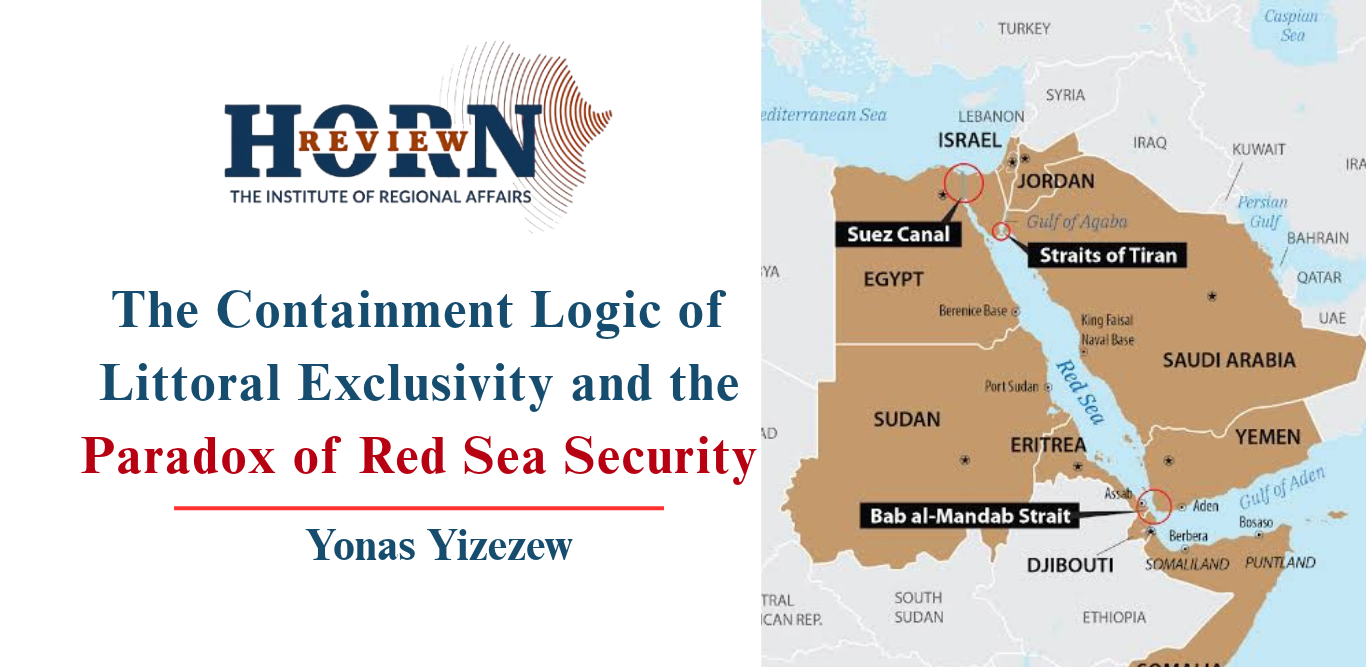
Meta Title: Egypt’s Red Sea Containment Strategy: Littoral Exclusivity vs. Ethiopia’s Maritime Rights
Meta Description: Analyzing how Egypt uses “littoral exclusivity” to contain Ethiopia in the Red Sea. Covers the Somalia-Sudan encirclement, GERD linkage, and why international law challenges this doctrine.
Focus Keyword: Egypt Red Sea containment strategy Ethiopia
Slug: /egypt-red-sea-containment-strategy-ethiopia-littoral-exclusivity
Egypt’s Red Sea Containment Strategy: How Littoral Exclusivity Targets Ethiopia’s Strategic Access
Throughout history, rival powers have employed a consistent toolkit to constrain neighbors: restricting strategic space, preserving dependencies, denying independent capacity in critical domains, and shaping the regional environment to keep a rival’s growth “manageable.” Today, this playbook is visibly unfolding in the Horn of Africa. Egypt’s Red Sea containment strategy increasingly relies on a doctrine of littoral exclusivity—the assertion that only coastal states hold legitimate authority over Red Sea security and access arrangements—to systematically limit Ethiopia’s options, economic security, and regional influence.
Defining Littoral Exclusivity: A Modern Containment Tool
Classic containment aims to restrict the expansion of a rival power. Littoral exclusivity achieves a similar result by leveraging control of the coastal interface and strategic chokepoints—like the Bab el-Mandeb Strait—to hem in a neighboring continental or landlocked power’s reach, trade options, and naval aspirations.
In the current context, this doctrine asserts that only states with a coastline on the Red Sea may have a say in its security architecture, access arrangements, and political frameworks. When applied selectively against a proximate, non-littoral power like Ethiopia—and merged with broader mechanisms of influence building—it functions precisely as containment. The objective is clear: restrict Ethiopia’s strategic options, alliance choices, and ability to project influence, thereby preserving the dominant littoral state’s regional primacy.
The Architecture of Encirclement: Egypt’s Multi-Front Pressure
Instead of confronting Ethiopia solely through bilateral channels, Cairo has rallied support by doubling down on military, diplomatic, and economic ties with the states surrounding its southern rival. Defense protocols, troop deployments, port access arrangements, and political alignment have created a strategic arc of influence.
Forward Positioning in Somalia and Sudan
Egypt’s forward positioning in Somalia and Sudan illustrates a deliberate effort to limit Ethiopia’s freedom of action on multiple flanks. Any Ethiopian move to secure port access—most notably the 2024 Memorandum of Understanding with Somaliland envisioning port facilities and a potential naval presence—is met with joint statements rejecting non-littoral involvement.
The New Alamein Summit and Diplomatic Isolation
At high-profile gatherings like the New Alamein meeting (Egypt, Eritrea, Sudan, Somalia) and in bilateral statements with Asmara, Egyptian officials have insisted that Red Sea security belongs solely to coastal states. This diplomatic offensive seeks to codify the exclusivity doctrine into a regional norm, effectively stripping Ethiopia’s maritime initiatives of legitimacy before they materialize.
Somalia’s Ambiguous Stance
Somalia occupies a distinct, contradictory position within this arc. It is the only member maintaining functional diplomatic relations with Addis Ababa. President Hassan Sheikh Mohamud has publicly expressed support for Ethiopia’s sea access and indicated openness to facilitating it. However, Mogadishu’s political and strategic alignment with Cairo’s regional strategy suggests a gap between rhetorical flexibility and actionable policy, reinforcing the encirclement dynamic.
Issue Linkage: Weaponizing the GERD Dispute for Maritime Leverage
A critical pillar of this strategy is issue linkage—deliberately connecting pressure in one domain to concessions in another. Egypt has long opposed the Grand Ethiopian Renaissance Dam (GERD), and the exclusivity doctrine now sits alongside this hydraulic nationalism.
By linking the Nile water dispute with Ethiopia’s pursuit of maritime access, Cairo multiplies its points of leverage. Early 2024 reports from The National News indicated Egypt was prepared to support Ethiopia’s commercial Red Sea access if Addis Ababa showed flexibility on the GERD. Although Cairo later denied the report, the signaling serves a strategic purpose: it tests Ethiopia’s willingness to trade maritime sovereignty for water security and confirms the instrumental nature of the exclusivity rhetoric. The doctrine appears less an absolute legal principle than a bargaining chip.
Related Reading: Grand Ethiopian Renaissance Dam (GERD) Official Updates
Why Littoral Exclusivity Fails the Test of International Law and Reality
Absolute claims that only coastal states decide Red Sea affairs clash fundamentally with the practical realities of the waterway and established international precedent.
The Piracy Precedent: UNSC Resolution 1816
The international response to piracy off the Somali coast provides a definitive legal counter-narrative. Following the 2008 escalation, the UN Security Council adopted Resolution 1816, authorizing states cooperating with Somalia’s Transitional Federal Government to enter Somali territorial waters and use “all necessary means” to repress piracy.
This decision recognized that maritime insecurity was not merely a coastal problem—it threatened international shipping, humanitarian deliveries, and global commercial routes. The subsequent deployment of naval forces by the EU (Operation Atalanta), NATO, China, India, and others established a precedent: when vital international interests are at stake, the “exclusive concern” of littoral states is legally and practically overridden. The recent resurgence of piracy reinforces that Red Sea security cannot be the exclusive preserve of coastal states.
Legal Reference: UN Security Council Resolution 1816 (2008) Mandate
Extra-Regional Powers and the Saudi-Led Inclusive Alternative
The Red Sea hosts sustained naval presences from extra-regional powers protecting freedom of navigation. Furthermore, the military confrontation involving the Houthis and Saudi Arabia has exacerbated regional insecurity, undermining the feasibility of a closed, littoral-only security architecture.
Recognizing this, Riyadh has pursued pragmatic, inclusive arrangements. Saudi Arabia launched a multinational maritime defense coalition inviting a diverse group of Arab, African, and Asian states—including non-littoral countries—to discuss maritime security. This initiative highlights that rigid exclusivity is incompatible with the Red Sea’s function as a global lifeline and the region’s deep interdependence.
Ethiopia’s Indispensable Security Role
The containment narrative also ignores Ethiopia’s concrete contributions to regional stability. For decades, Addis Ababa has been a primary contributor to counterterrorism efforts in Somalia, playing a pivotal role in African Union peace support operations and the fight against Al-Shabaab.
Ethiopia’s security environment is inextricably linked to the Red Sea. Threats posed by Al-Shabaab, domestic insurgent groups with cross-border ties, and maritime insecurity directly affect its national security. Reported links between the Houthis and Al-Shabaab across the Gulf of Aden add a dangerous new layer, potentially creating a unified threat arc that no single littoral state can manage alone. Excluding the region’s largest security contributor from maritime governance weakens the collective response capacity.
Conclusion: The Cost of Instrumentalized Exclusivity
The rigid application of littoral exclusivity risks deepening regional polarization, narrowing diplomatic space, and raising the costs of any future cooperative arrangement. History and law demonstrate that absolute claims of coastal monopoly are unsustainable when vital interests of non-littoral states, freedom of navigation, and regional interdependence are at stake.
Egypt’s reported willingness to trade its own doctrine for GERD concessions reveals the strategy’s transactional core. This risks leaving the neighbors who echoed Cairo’s “littoral only” position appearing as instruments of a bargaining strategy that was never absolute. For the Horn of Africa, sustainable security requires inclusive frameworks—like the Saudi-led coalition or UN-mandated mechanisms—that reflect the Red Sea’s reality as a shared global commons, not a closed lake for the exclusive few.
Key Takeaways:
- Doctrine: Egypt employs “littoral exclusivity” as a containment tool to deny Ethiopia Red Sea agency.
- Mechanisms: Encirclement via Somalia/Sudan/Eritrea, diplomatic summits (New Alamein), and GERD-maritime issue linkage.
- Legal Reality: UNSC Res 1816 (piracy) and extra-regional naval presence prove non-littoral participation is established practice.
- Regional Trend: Saudi Arabia’s inclusive coalition offers a viable alternative to exclusionary blocs.
- Strategic Cost: Instrumentalizing the doctrine for GERD leverage undermines its legitimacy and regional trust.
