




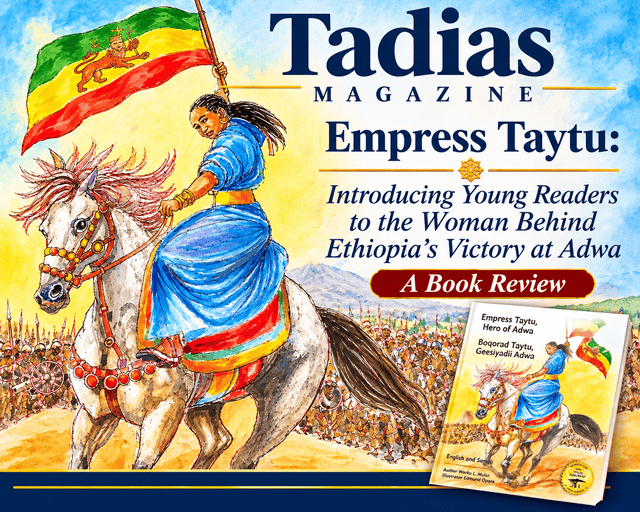
Empress Taytu Betul: Hero of Adwa – A New Children’s Book Inspires the Next Generation
A groundbreaking children’s publishing initiative is bridging the gap between the Ethiopian Diaspora and their ancestral heritage. Open Hearts Big Dreams (OHBD), through its Ready Set Go Books collection, is producing high-quality, bilingual literature that brings Ethiopian history, languages, and storytelling traditions to young readers worldwide.
Launching a new series of literary spotlights, we begin with a pivotal title: Empress Taytu, Hero of Adwa: From Eager Student to Strategic Leader. This book addresses a critical gap in global historical narratives by centering one of Africa’s most formidable female strategists.
<section id="why-empress-taytu-matters">
    <h2>Why Empress Taytu Betul Matters in Ethiopian History</h2>
    <p><strong>Empress Taytu Betul</strong> (c. 1851–1918) stands as a towering figure in the preservation of Ethiopian sovereignty. As the wife and trusted political partner of <a href="https://en.wikipedia.org/wiki/Menelik_II" target="_blank" rel="noopener noreferrer">Emperor Menelik II</a>, her influence extended far beyond the traditional role of a consort. She was a shrewd diplomat, a fierce defender of national borders, and a military strategist whose decisions altered the trajectory of the continent.</p>

    <h3>The Treaty of Wuchale: Diplomacy vs. Deception</h3>
    <p>One of Taytu’s most defining moments came during the negotiation of the <a href="https://en.wikipedia.org/wiki/Treaty_of_Wuchale" target="_blank" rel="noopener noreferrer">Treaty of Wuchale (1889)</a> with Italy. The treaty contained a deliberate discrepancy between the Amharic and Italian versions: the Amharic text offered Ethiopia the <em>option</em> to use Italy for foreign affairs, while the Italian version made it <em>mandatory</em>, effectively establishing a protectorate.</p>
    <p>Taytu’s linguistic vigilance and political acumen exposed the duplicity. Her famous refusal—declaring, "We have also made it known to the powers that the said article, as it is written in our language, has another meaning"—galvanized the Emperor and the nobility to reject the treaty, setting the stage for war.</p>

    <h3>Strategic Leadership at the Battle of Adwa</h3>
    <p>During the <a href="https://en.wikipedia.org/wiki/Battle_of_Adwa" target="_blank" rel="noopener noreferrer">Battle of Adwa (March 1, 1896)</a>, Taytu commanded her own battalion of cannoneers and managed critical logistics, including water supply lines—a decisive factor in the arid terrain. Her leadership contributed directly to the historic victory where Ethiopian forces decisively defeated the invading Italian army, securing Ethiopia’s status as the only African nation to successfully resist European colonization during the Scramble for Africa.</p>
</section>

<section id="book-review-empress-taytu-hero-of-adwa">
    <h2>Book Review: <cite>Empress Taytu, Hero of Adwa: From Eager Student to Strategic Leader</cite></h2>

    <div class="book-meta">
        <ul>
            <li><strong>Title:</strong> Empress Taytu, Hero of Adwa: From Eager Student to Strategic Leader</li>
            <li><strong>Author:</strong> Worku L. Mulat</li>
            <li><strong>Collection:</strong> OHBD Ready Set Go Books</li>
            <li><strong>Publisher:</strong> Open Hearts Big Dreams</li>
        </ul>
    </div>

    <h3>Reframing History for Young Minds</h3>
    <p>The subtitle, <em>From Eager Student to Strategic Leader</em>, signals a deliberate pedagogical approach. Rather than presenting Taytu as a static icon of the past, the narrative traces her intellectual formation. It highlights her education, her fluency in <a href="https://en.wikipedia.org/wiki/Ge%27ez_language" target="_blank" rel="noopener noreferrer">Ge'ez</a> and Amharic, and her deep understanding of international law and geography—tools she wielded as effectively as any weapon.</p>
    <p>This framing offers young readers, particularly girls, a powerful model of <strong>female leadership</strong> rooted in scholarship, critical thinking, and moral courage.</p>

    <h3>Bridging the Diaspora Distance</h3>
    <p>For Ethiopian families raising children abroad, transmitting cultural memory presents unique challenges. Geographic distance often separates youth from the oral traditions, languages, and physical landmarks that anchor identity. Children’s literature serves as a vital <strong>cultural bridge</strong>, offering an accessible entry point to complex historical events.</p>
    <p>This book facilitates intergenerational dialogue, allowing parents and grandparents to share nuances of the <a href="https://en.wikipedia.org/wiki/First_Italo-Ethiopian_War" target="_blank" rel="noopener noreferrer">First Italo-Ethiopian War</a> and the significance of Adwa in a format that resonates with early readers.</p>
</section>

<section id="ohbd-mission-multilingual-publishing">
    <h2>The OHBD Model: Multilingual Publishing for Cultural Preservation</h2>
    <p>Open Hearts Big Dreams distinguishes itself through a commitment to <strong>linguistic diversity</strong>. To date, the organization has published nearly <strong>200 bilingual titles</strong> across <strong>14 Ethiopian languages</strong>, including Amharic, Tigrinya, Afaan Oromo, Somali, and Sidama.</p>
    <p>This approach serves a dual purpose: it supports literacy in mother tongues—aligned with UNESCO recommendations for <a href="https://en.unesco.org/themes/literacy/multilingual-education" target="_blank" rel="noopener noreferrer">multilingual education</a>—and validates the rich tapestry of Ethiopia’s ethnic communities. By featuring stories from regions like Gambella, Harar, and the South Omo Zone, OHBD ensures that "Ethiopian history" is not a monolith but a mosaic of voices.</p>
</section>

<section id="whats-next-in-the-series">
    <h2>What’s Next: Expanding the Ethiopian Literary Canon</h2>
    <p>This review inaugurates a series dedicated to uncovering the breadth of the Ready Set Go Books catalog. Upcoming spotlights will traverse Ethiopia’s diverse regions and storytelling traditions, including:</p>
    <ul>
        <li><strong>Anuak Folktales:</strong> Exploring oral traditions from the Gambella region, such as <cite>The Lonely Nile Perch</cite>.</li>
        <li><strong>Historical Biographies:</strong> <cite>The Story of Malik Ambar</cite>, tracing the extraordinary journey of an Ethiopian slave who became a powerful regent in the Deccan Sultanate of India.</li>
        <li><strong>Regional Cultural Stories:</strong> <cite>Yellow from Harar</cite> (celebrating the UNESCO World Heritage site of <a href="https://whc.unesco.org/en/list/1895" target="_blank" rel="noopener noreferrer">Harar Jugol</a>) and <cite>When Water Comes to Maji</cite> (highlighting life in the Bench Maji zone).</li>
    </ul>
    <p>Through these selections, the series aims to build a comprehensive library that reflects the full spectrum of Ethiopian identity—past and present.</p>
</section>

<section id="where-to-find-the-book">
    <h2>Where to Find <cite>Empress Taytu, Hero of Adwa</cite></h2>
    <p>The book is available globally through the OHBD Ready Set Go Books platform. Educators, librarians, and families can access the title and explore the full bilingual catalog via the link below:</p>
    <p><a href="https://ohbd-rsgbooks.com/our-books/empress-taytu-hero-of-adwa/" target="_blank" rel="noopener noreferrer" class="cta-button">View Book on OHBD Ready Set Go Books</a></p>
</section>