




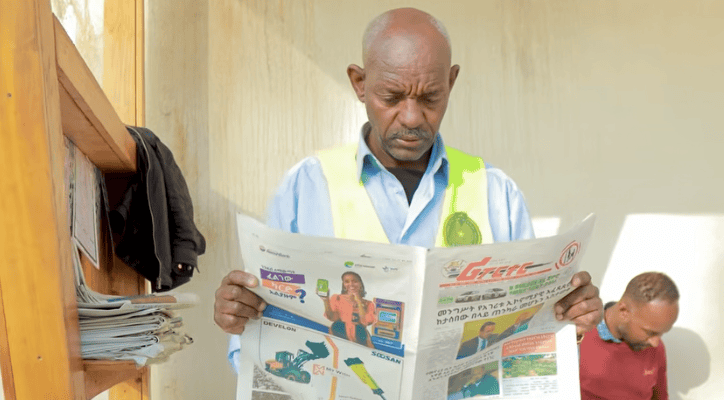
Ethiopia Suspends The Reporter Indefinitely: CPJ Condemns Escalating Crackdown on Independent Press
Nairobi — Ethiopian authorities have indefinitely suspended the registration of The Reporter, one of the nation’s oldest and most prominent independent newspapers, in a move the Committee to Protect Journalists (CPJ) has denounced as a blatant act of censorship. The suspension, announced November 2 by the Ethiopian Media Authority (EMA), marks the latest escalation in a systematic campaign targeting independent media outlets operating in the country.
Regulator Weaponizes Vague ‘National Interest’ Clauses
In a statement published on its official Facebook page, the EMA accused The Reporter—including its Amharic and English-language editions, digital platforms, and YouTube channel—of repeatedly publishing reports that “undermine national interests, damage Ethiopia’s image, threaten national security, and violate journalistic ethics.”
The regulator invoked the 2021 Ethiopian Media Proclamation to suspend the registration certificate of the newspaper’s publisher, Media and Communication Center PLC, for an “indefinite period.” Notably, the EMA did not cite a single specific article or broadcast to substantiate its sweeping allegations of “distorted information,” lack of balance, or reliance on “unconfirmed information.” Instead, the authority claimed it had monitored the outlet for over a year and issued a final warning prior to the suspension.
“Ethiopia’s media regulator has become an instrument of censorship, using vague and sweeping allegations of threats to ‘national interests’ to systematically punish independent journalism,” said Muthoki Mumo, CPJ Africa Program Coordinator. “Ethiopian authorities should immediately reverse this punitive decision, stop weaponizing media regulations to suppress scrutiny, and end their relentless campaign to dismantle the free press.”
Retaliation for Editorial Criticism?
The suspension arrived just two days after The Reporter published a bold editorial titled “Press Freedom Is Not A Luxury!”. The piece explicitly criticized the government for treating independent reporting as a national security threat and demanded the release of journalists detained without charge or in violation of constitutional bail guarantees.
Established in 1996, The Reporter has long been a cornerstone of the Ethiopian media landscape, providing coverage in both Amharic and English. The timing of the suspension strongly suggests a retaliatory motive aimed at silencing dissenting editorial voices ahead of a volatile political period.
A Pattern of Systematic Media Suppression
The action against The Reporter is not an isolated incident but part of a documented pattern of regulatory capture and press suppression orchestrated by the EMA throughout 2025 and 2026. CPJ documentation highlights a rapid acceleration in the revocation of licenses and accreditation:
- Addis Standard: In February 2026, the EMA revoked the license of Addis Standard, another leading independent outlet.
- Wazema Radio: Simultaneously, the license of Wazema Radio was revoked.
- Reuters: The EMA suspended the accreditation of Reuters journalists for six months in early 2026 following an investigative report; accreditation was only reinstated in August 2026.
- Deutsche Welle (DW): A ban on two Deutsche Welle journalists, imposed in 2025, remains in effect as of November 2026.
Journalists Face Arbitrary Detention
Beyond institutional bans, individual journalists continue to face physical reprisals. Earlier in 2026:
- Bewket Abebe, a journalist with The Reporter Magazine, was detained for three days in May.
- Yonas Kedir, an editor at Addis Standard, was held for a day in August during a newsroom raid where security forces seized equipment.
These incidents underscore a climate of fear where regulatory sanctions are backed by the threat of arbitrary arrest and physical intimidation.
International Obligations and Domestic Law
Ethiopia is a signatory to the International Covenant on Civil and Political Rights (ICCPR) and the African Charter on Human and Peoples’ Rights, both of which guarantee freedom of expression. Domestically, the Federal Democratic Republic of Ethiopia Constitution (Article 29) explicitly protects freedom of the press and prohibits censorship.
However, the 2021 Media Proclamation—cited by the EMA in this suspension—has been widely criticized by international press freedom organizations, including Article 19 and Reporters Without Borders (RSF), for retaining restrictive provisions that grant the executive branch excessive discretionary power to define “national security” and “public order” in ways that stifle legitimate journalism.
Call for Immediate Reinstatement
As of the publication of this report, CPJ’s request for comment sent to the Ethiopian Media Authority on November 5 had not received a response. The indefinite nature of the suspension—lacking a defined timeline or specific legal pathway for appeal—effectively functions as a permanent ban unless reversed by political directive.
Press freedom advocates urge the international community, including the African Union (headquartered in Addis Ababa) and bilateral partners, to pressure Ethiopian authorities to:
- Immediately lift the indefinite suspension of The Reporter and restore its registration certificate.
- Amend the 2021 Media Proclamation to align with international standards, removing vague “national interest” clauses used to justify censorship.
- End the practice of arbitrary detention of journalists and ensure the safety of media workers.
- Reinstate all revoked licenses and accreditations, including those of Addis Standard, Wazema Radio, and DW correspondents.
The silencing of The Reporter—a publication that has navigated three decades of Ethiopian political history—signals a dangerous inflection point for the country’s information ecosystem. Without immediate reversal, Ethiopia risks cementing a media environment where only state-sanctioned narratives survive.
