




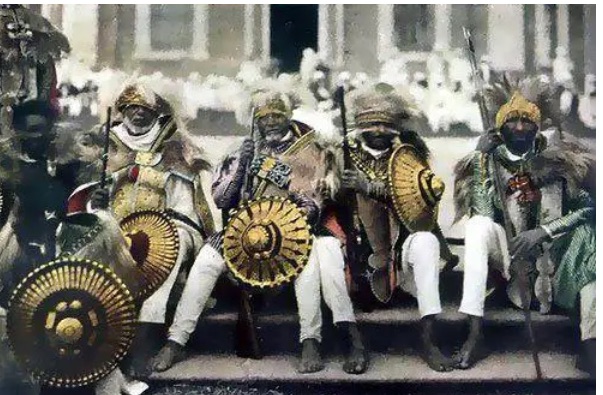
Ethiopia must distinguish the historic Fano from the contemporary insurgency that has appropriated its name, reputation and patriotic symbolism, because the Ethiopian tri-color, crosses worn around fighters’ necks and the language of Amhara survival cannot exempt an armed political organizations from scrutiny over its origins, conduct and alliances.
This distinction has become even more important as forces that, only a few years ago, fought one another—and were presented to their respective communities as existential enemies—now announce their cooperation against the Ethiopian government. Such a dramatic reversal and display of political opportunism are virtually unprecedented in Ethiopian history. Something deeply unnatural and inorganic appears to be taking shape.
The Hijacking of Fano
The historic Fano tradition did not begin with today’s commanders and did not begin with Eritrea, because the name has a much older, and proud Ethiopian history associated with volunteers who defended their communities and country, including people who mobilized against the fascist invasion of Mussolini (1935), more recently, fighters who defended Amhara communities during the TPLF advance.
Today’s movement, however, is a false imitation of Fano—fundamentally different in both character and provenance from Ethiopia’s historic Fano tradition. It has been alleged that the contemporary organization was cultivated by Eritrea to serve as a proxy against the Ethiopian state. A widely circulated social-media video attributed to Professor Hassan shows him declaring that “this Fano was launched by Shabia,” referring to the present political and armed formation rather than the traditional Ethiopian institution. Although the video’s provenance and full context should be independently verified, the statement supports the allegation that an established Ethiopian symbol was appropriated and repurposed to divide and attack Ethiopia from within. It was a deeply cynical—and strategically calculated—act by the Eritrean regime.
The argument is therefore not that Shabia invented Fano as an Ethiopian historical tradition, but that the prestigious name Fano was appropriated and attached to a contemporary armed political enterprise, allowing that movement to inherit the patriotic reputation of people who came before it.
This appropriation matters because someone carrying the Ethiopian tri-colour can automatically be presented as a patriot, someone wearing a cross can acquire religious legitimacy, and an armed organization calling itself “Fano” can portray scrutiny of its activities as hostility toward the Amhara people themselves, although none of those symbols determines whether an organizations actions or political objectives represent the population whose history it invokes.
Genocide as Mobilization
Roughly 80 percent of rallies promoting an “Amhara genocide” narrative were organized by Shabia linked actors or substantially participated in by Shabia supporters, which takes on greater political significance when considered alongside Professor Hassan’s allegation concerning the origins of “this Fano.”
The concern raised by these allegations is that genuine killings and suffering among Amhara civilians were transformed into an existential political narrative, that the narrative mobilized frightened communities, and that an armed organization carrying the historic name Fano then presented itself as the indispensable defender of Amhara survival.
None of this makes the suffering of Amhara civilians imaginary, because massacres, displacement and atrocities against Amharas demand accountability, but the suffering of victims and the political project constructed around their suffering are not the same thing.
An Amhara civilian murdered because of his identity is not an insurgent commander, a displaced Amhara family does not automatically endorse an armed rebellion, and the grief of a community cannot become the political property of whichever organization succeeds in presenting itself as that community’s protector.
The Manifestos and Today’s Alliance
The ideological history of the forces now moving toward cooperation makes the development particularly striking, because movements associated with Shabia, the TPLF and Oromo nationalism developed political programs and manifestos interpreting Ethiopian history through nationality, oppression and self determination, while narratives of Amhara political domination became important elements of those traditions.
The historical EPLF manifesto, Our Struggle and Its Goals, dates from 1971, while scholarship examining the document has discussed its portrayal of Ethiopia’s ruling structure and the place assigned to Amhara political dominance within that interpretation.
The TPLF’s early political program similarly emerged from a revolutionary interpretation of Ethiopian nationality politics, while Oromo nationalist movements developed their own political programs centered on Oromo oppression and self determination, although the different organizations and documents should not be treated as identical.
What matters today is that political traditions that many Amhara activists have spent decades accusing of constructing narratives hostile to Amharas are now among the forces with which the contemporary organization calling itself Fano is prepared to cooperate.
The earlier message to ordinary people was not simply that these organizations had different political programs, because the language used by activists frequently presented the struggle as existential and armed mobilization as necessary for Amhara survival.
Enter Ximdo
The controversy surrounding Ximdo—pronounced “Tsimdo” and promoted, somewhat ironically, by the Eritrean EritreaNEXT Policy Institute—brings these developments into sharper focus. Its organizers describe it as a grassroots peace initiative linking communities across Eritrea, Tigray, Afar, Amhara, and neighboring countries. However, there is a broader pattern of coordination among “Fano” factions, TPLF-linked forces, the OLA, and other armed organizations opposed to Ethiopia’s federal government. What makes this alleged alignment so extraordinary is that these forces fought one another only a few years ago, while their leaders and constituencies traded accusations of atrocities and crimes against humanity.
These forces do not suddenly share the same ideology, because Fano and TPLF retain serious territorial disputes while Fano and OLA have major ideological and territorial disagreements of their own, yet hostility toward the federal government has created sufficient common interest for political and military cooperation to be discussed.
This is particularly significant because Fano forces fought the TPLF during the Tigray war, while Amhara activists have also accused OLA forces of atrocities against Amhara civilians, meaning that organizations previously presented as threats to Amhara survival can now occupy the same broader anti government political space as an armed movement claiming to represent those victims.
Zemene Says the Alliance Exists
Whatever dispute remains over whether Fano should formally be described as a member of Ximdo, Zemene Kassie’s own August 2026 announcement establishes his position on broader cooperation, because he told Le Temps that alliances had been established with several organizations, including forces from Tigray, as part of a struggle whose stated objective is removing Prime Minister Abiy Ahmed.
Zemene’s interview announcing the alliances therefore deserves to be read alongside the rhetoric previously used to mobilize Amharas, because subsequent reporting describes a coalition involving Fano, TPLF, OLA and several other armed organizations, with Zemene saying that Fano supports the TPLF’s struggle.
This creates a question that cannot be resolved by changing the name of the coalition, because if TPLF forces were presented during the northern war as an existential enemy of Amharas, and if Oromo armed organizations were presented by Amhara activists as perpetrators of violence described as genocide, then the victims are entitled to ask what happened to the political narrative constructed around their suffering.
When the Victims Become Pawns
People were killed, families buried relatives, communities were displaced, young people were galvanized and civilians were repeatedly told that particular political and armed movements threatened their very existence, yet organizations claiming to represent those victims can now decide that cooperation with forces associated with yesterday’s tormentor enemies serves a larger struggle against the federal government.
The perpetrators claiming to represent the victims therefore move toward the same political battlefield, while the people whose deaths supplied the emotional force behind the tribal range needed for armed mobilization cannot return from their graves and renegotiate the political meaning assigned to their suffering.
That is how victims become pawns in a political game, because their losses remain permanent while alliances created in their names can change whenever political strategy changes. The dead cannot change alliances, families cannot undo massacres and displaced communities cannot recover lost years merely because armed leaders have discovered that yesterday’s enemy has become useful today.
A Cruel Political Joke on the Victims
Taken together, Eritrean support for competing armed movements point toward the same strategic outcome: an Ethiopia weakened by internal conflict, fragmented into armed constituencies, and increasingly difficult to govern, while neighboring powers gain leverage over a country consumed by conflict among its own citizens.
Recent security assessments allege that Eritrea provided Fano forces with training and weapons during the Tigray war. They also describe emerging cooperation between Fano and TPLF-linked forces, despite the long and bitter history of conflict between Eritrea and the TPLF.
Viewed alongside allegations concerning the origins of the contemporary Fano movement, this development is deeply troubling. Ethiopians can be mobilized through competing narratives of existential danger and encouraged to regard other Ethiopian communities as mortal enemies—only to discover that the organizations claiming to defend those supposedly irreconcilable communities can cooperate when their political interests change.
That is the cruelest irony for the victims. Ordinary people are mobilized through appeals to the blood of their kin and asked to sacrifice themselves against a designated enemy, while their self-appointed defenders retain the freedom to reverse course and cooperate with the very political forces they once invoked to justify violence.
Reclaim the Name Fano
The historic name Fano must therefore be separated from the contemporary armed political terrorism, because the Fano tradition belongs to people who defended their communities and country, while no modern insurgent organization should inherit that honor merely by adopting the name, carrying the Ethiopian tricolor and placing crosses around the necks of its fighters.
The Professor Hassan video, in which he is presented as alleging that “this Fano” was launched by Shabia, goes directly to this distinction, while Zemene Kassie’s subsequent announcement of cooperation with Tigrayan and other armed forces makes examination of the contemporary movement’s political history even more important.
The central issue is no longer difficult to see, because political traditions associated with Shabia, TPLF and Oromo nationalism, whose manifestos and programs many Amhara activists have long regarded as hostile to their people, can now find themselves in cooperation with an armed organization claiming the historic name Fano and claiming to defend Amhara survival.
This does not erase the suffering of Amharas, nor does it assign collective responsibility to Tigrayans, Oromos or Eritreans for crimes committed by armed actors, but it does show why civilian suffering must never become the property of political organizations that can change their alliances while victims live permanently with the consequences.
Ethiopians should therefore scrutinize a politics in which citizens are galvanized through tribal rage and fear, their deaths become political ammunition, respected historical identities are appropriated by contemporary armed movements, and forces previously presented as mortal enemies can later cooperate against a different opponent.
The Ethiopian flag belongs to Ethiopia, the cross belongs to the faith, the historic name Fano belongs to history, and the suffering of all civilians belongs to the victims rather than to to insurgent proxies of a foreign entity or political coalition seeking to use it.
Ethiopians are wide awake now.
